
Build a data quality summary report (preferred alias)
Source:R/api-reports.R
data_quality_report.RdBuild a data quality summary report (preferred alias)
Usage
data_quality_report(
  fit,
  data = NULL,
  person = NULL,
  facets = NULL,
  score = NULL,
  weight = NULL,
  min_category_count = 10,
  dominant_category_cutoff = 0.95,
  include_fixed = FALSE
)
Arguments
- fit
Output from
fit_mfrm().- data
Optional raw data frame used for row-level review.
- person
Optional person column name in
data.- facets
Optional facet column names in
data.- score
Optional score column name in
data.- weight
Optional weight column name in
data.- min_category_count
Minimum raw or weighted count used to label a non-zero facet-level score category as sparse. Default
10.- dominant_category_cutoff
Proportion in
(0, 1]used to flag a facet level whose responses are dominated by one score category. Default0.95.- include_fixed
If
TRUE, include a legacy-compatible fixed-width text block.
Details
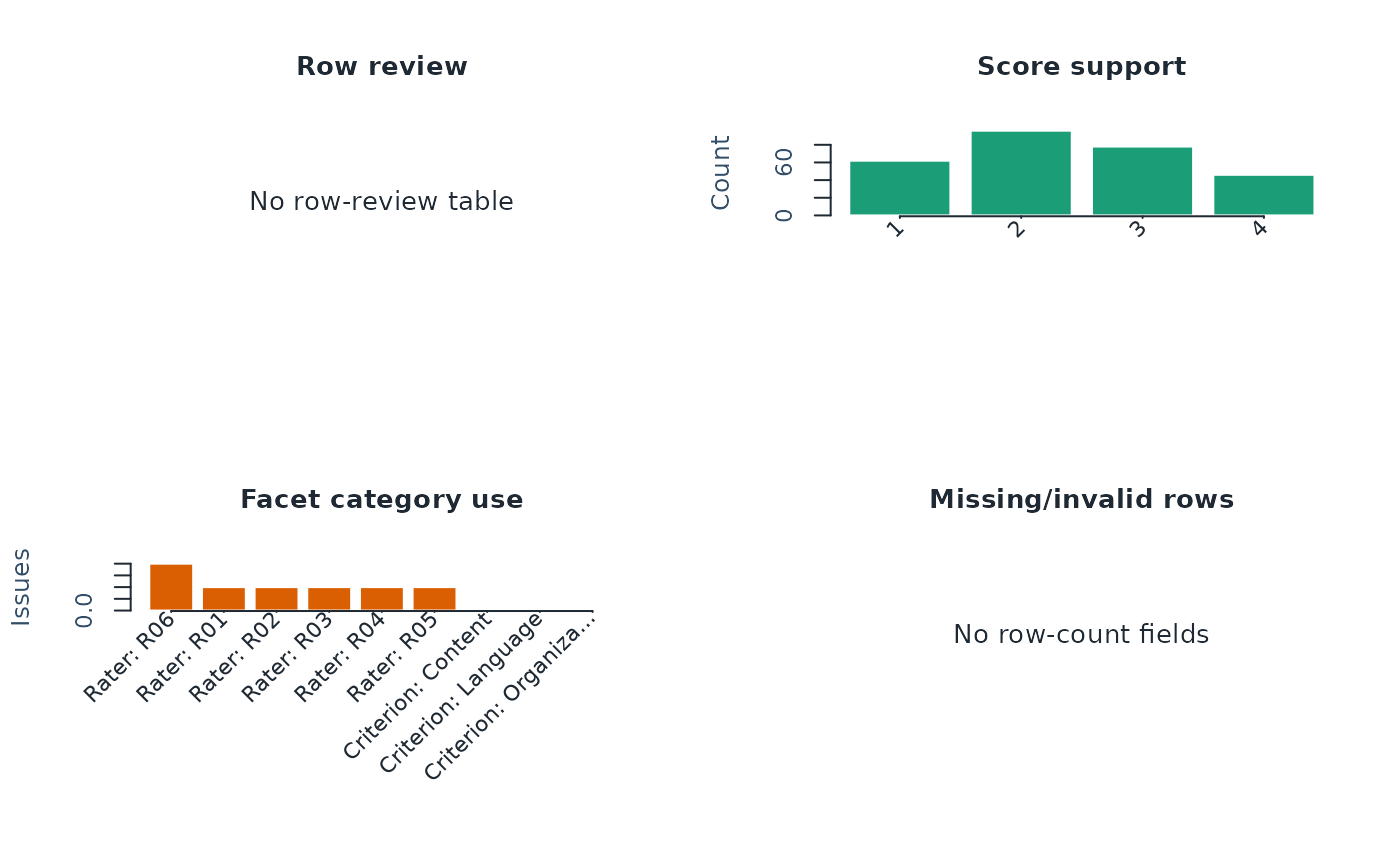
summary(out) is supported through summary().
plot(out) is dispatched through plot() for class
mfrm_data_quality (type = "dashboard", "quality_flags",
"row_review", "category_counts", "score_support",
"facet_category_usage", "facet_response_patterns", "score_map",
"missing_rows").
Interpreting output
summary: retained/dropped row overview.quality_overview: area-level QC status for rows, score support, facet-category use, and design matching.quality_flags: prioritized QC flags with counts and recommended next actions. This is not an item/person/rater table.row_review: reason-level breakdown for data issues.category_counts: post-filter category usage, including retained zero-count score-support categories.score_support_review: quick view of zero-count boundary/intermediate categories and their threshold-functioning caveats.category_usage_by_facet: facet-level category counts over the retained score support.category_usage_summary: per-facet-level zero/sparse category summary.facet_response_patterns: facet-level response-pattern summaries, including single-category and dominant-category use.caveats: user-facing score-support warnings, including cases where non-consecutive original labels such as1, 2, 4, 5were recoded becausekeep_original = FALSE.score_map: original-to-internal score mapping used when labels are recoded.unknown_elements: facet levels in raw data but not in fitted design.
Local category avoidance is not automatically a GPCM problem
Suppose a declared 1–10 scale is observed globally, but one rater uses only
scores 3–8. If other raters use 1, 2, 9, and 10, the shared score support is
not globally missing. The affected rater instead has local zero-category use:
inspect category_usage_by_facet, category_usage_summary, and
plot(out, type = "facet_category_usage"). This pattern can reflect range
restriction, assignment/case mix, sparse information, or operational scoring
practice; the table alone does not identify the cause.
Do not select GPCM merely to absorb category avoidance. GPCM changes the
designated step/slope owner's threshold and discrimination structure; it does
not repair a rater's restricted use of the rubric. When the affected rater is
itself the step_facet/slope_facet owner, local category gaps can also
weaken owner-specific PCM/GPCM parameter support and the fit-readiness result
must be checked. Under RSM, or when another facet owns the steps, the same
local pattern remains important response-use evidence without automatically
becoming a distinct response model.
Typical workflow
Run
data_quality_report(...)with raw data.Check
summary(out)andplot(out, type = "dashboard"), then inspectquality_flags, score-support, score-map, facet-response-pattern, and missing/unknown element sections as needed.Resolve missing values, score-support gaps, and sparse categories before final estimation/reporting.
Examples
# \donttest{
# Load the package and example ratings
library(mfrmr)
toy <- load_mfrmr_data("example_operational")
# Fit the model
fit <- fit_mfrm(
data = toy,
person = "Person",
facets = c("Rater", "Criterion"),
score = "Score",
method = "MML",
model = "RSM"
)
# Review the input-data checks recorded with this fit
quality <- data_quality_report(fit)
summary(quality)
#> mfrmr Data Quality Summary
#> Class: mfrm_data_quality
#> Components: 14
#>
#> Data quality overview
#> TotalLinesInData TotalDataLines TotalNonBlankResponsesFound
#> NA NA NA
#> ValidResponsesUsedForEstimation ZeroCountScoreCategories
#> 282 0
#> IntermediateZeroCountScoreCategories FacetLevelsWithZeroCategories
#> 0 0
#> FacetLevelsWithIntermediateZeroCategories FacetLevelsWithSparseCategories
#> 0 6
#> FacetLevelsWithSingleCategoryUse FacetLevelsWithDominantCategoryUse
#> 0 0
#> FacetLevelsWithBoundaryOnlyUse ScoreSupportCaveats
#> 0 0
#>
#> Review rows: quality_flags
#> Area Severity Flag Count
#> Facet category use review Facet levels have sparse category use 6
#> Unit PercentOfData
#> facet levels NA
#> Action
#> Interpret category-functioning evidence for these levels as sparse.
#>
#> Settings
#> Setting Value
#> min_category_count 10
#> dominant_category_cutoff 0.95
#>
#> Notes
#> - Data quality summary for missingness, row status, score support, and
#> category usage.
#> - QC overview: 0 high-priority area(s), 1 review area(s).
#> - Priority QC flags: 1 flag(s), including 0 high-severity flag(s).
#> - Facet-level category use: 0 level(s) have zero-count categories; 0 have
#> zero-count intermediate categories; 6 have sparse non-zero categories.
# Draw the data-quality overview
plot(quality)
 # }
# }