Analyze the hierarchical structure of a rating design
Source:R/api-hierarchical-audit.R
analyze_hierarchical_structure.RdOne-stop review that combines the nesting, cross-tabulation, ICC, and
design-effect reports into a single object. Its summary feeds into
reporting_checklist() after checking the reviewed data against the fit.
Usage
analyze_hierarchical_structure(
  data,
  facets = NULL,
  person = "Person",
  score = "Score",
  compute_icc = TRUE,
  ci_method = c("none", "boot"),
  ci_level = 0.95,
  ci_boot_reps = 1000L,
  ci_boot_seed = NULL,
  igraph_layout = TRUE,
  icc_ci_method = NULL,
  icc_ci_level = NULL,
  icc_ci_boot_reps = NULL,
  icc_ci_boot_seed = NULL,
  missing = c("error", "omit")
)
Arguments
- data
Data frame in long format, or an
mfrm_fit(itsprep$datais used).- facets
Character vector of facet column names. When
datais anmfrm_fit, defaults tofit$prep$facet_names.- person
Person column name. Defaults to
"Person".- score
Score column name. Defaults to
"Score".- compute_icc
Logical; if
TRUEandlme4is available, adds ICC and design-effect tables.- ci_method
ICC confidence-interval method passed through to
compute_facet_icc(). One of"none"(default, point estimate only) or"boot". The former"profile"method is refused because it did not calculate an ICC profile-likelihood interval. Deprecated alias:icc_ci_method(kept for backward compatibility, emits a lifecycle warning).- ci_level
Confidence level when
ci_method != "none"; default0.95. Deprecated alias:icc_ci_level.- ci_boot_reps
Number of bootstrap replicates when
ci_method = "boot". Default1000. Deprecated alias:icc_ci_boot_reps.- ci_boot_seed
Optional RNG seed for reproducible bootstrap CIs. Deprecated alias:
icc_ci_boot_seed.- igraph_layout
Logical; if
TRUEandigraphis available, adds a connectivity component summary using a bipartite graph over person x facet levels.- icc_ci_method, icc_ci_level, icc_ci_boot_reps, icc_ci_boot_seed
Deprecated compatibility spellings of the
ci_*arguments above. Supplying a non-NULLvalue routes throughlifecycle::deprecate_warn()and overrides the canonicalci_*argument.- missing
Missing-value policy for the ICC and design-effect tables, passed to
compute_facet_icc(). Invalid input or model errors stop the requested ICC analysis. Nesting, cross-tabulation, and connectivity tables describe the supplied design, including rows excluded from the ICC model. Whendatais a fit, ICC row counts start from its stored fitted rows; they cannot recover exclusions made before fitting the MFRM.
Value
A list of class mfrm_hierarchical_structure with:
nesting: output ofdetect_facet_nesting().crosstabs: list of pairwise observation-count data.frames (long format, suitable for heatmap plotting).icc: output ofcompute_facet_icc()when requested.design_effect: output ofcompute_facet_design_effect()when requested.connectivity: named list with bipartite-graph component summary whenigraphis available.summary: one-row summary used by downstream reporting helpers.facets: character vector of facet names that were reviewed (echoed for downstream reporting helpers that need to label rows by review scope).data_identity: reviewed column roles, input row count and a compact fingerprint for reuse checks. The optional person column also contributes to nesting pair counts;summary$NFacetscounts the requestedfacets.
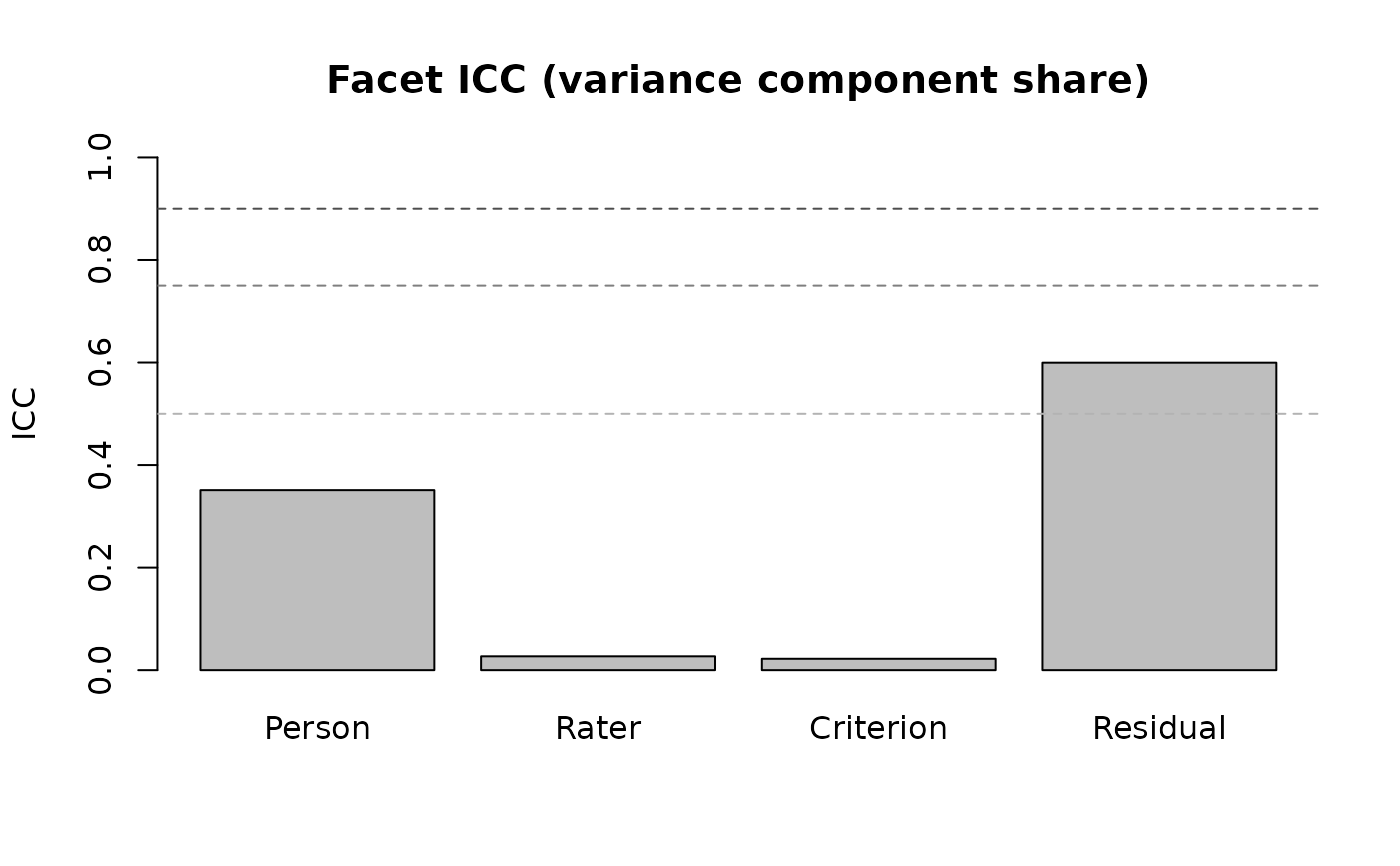
plot(x, type = "icc") draws variance shares and any available intervals
without an embedded title or footnote. Save its returned object as p and
use plot_data(p, "notes") to read the interval method or the reason bounds
are unavailable. These notes survive saveRDS()/readRDS(); they do not
change the underlying ICC estimates.
Interpreting output
nesting: adetect_facet_nesting()object with every facet pair classified as Crossed / Partially / Near-perfectly / Fully nested.crosstabs: list of(LevelA, LevelB, N)long-format tables, one per facet pair. Plot viaplot(x, type = "crosstab", pair = "FacetA__FacetB").icc: per-facet variance shares. Seecompute_facet_icc()for the two-scale interpretation.design_effect: per-facet design-effect approximations and descriptive equivalent row counts; not precision estimates for the full design.connectivity: number of bipartite components linking Person x facet levels. A single component is required for a common measurement scale; multiple components indicate a disconnected design.
Typical workflow
Optional: fit the MFRM with
fit_mfrm().Call
analyze_hierarchical_structure(fit)(or on the raw data).Read
summary(x)for the condensed view.Pass it as
hierarchical_structuretoreporting_checklist()and save the review withsaveRDS()when its full tables are needed later.build_mfrm_manifest()records a separate fit-level rating-count review; it does not accept or archive this structural-review object.
Saved-result reuse
A reporting checklist checks the reviewed column roles and retained rating
rows, including scores when an ICC table was computed. It accepts a subset
of fitted facets and reports that scope explicitly. Reviews from raw data
also work when the selected columns and rows match, using either canonical
Person/Score names or the fit's original source-column names.
Row order, unused factor levels, unused columns and MFRM estimates do not
affect this match. Nesting and row counts are unweighted; when ICC is absent,
the match does not depend on scores. These rules do not establish that a
partial review covers all facets or that the design supports valid inference.
A review of additional rows, other strata or columns absent from the fit
remains usable on its own, but cannot mark this fit's checklist item as
available. Recreate older reviews without data_identity from the saved
fit or matching retained rows and original options; no MFRM refit is needed.
See mfrmr_compatibility_layer.
References
McEwen, M. R. (2018). The effects of incomplete rating designs on results from many-facets-Rasch model analyses (Doctoral thesis, Brigham Young University). https://scholarsarchive.byu.edu/etd/6689/
Linacre, J. M. (2026). A User's Guide to FACETS, Version 4.5.0. Winsteps.com.
Kish, L. (1965). Survey Sampling. New York: Wiley.
Koo, T. K., & Li, M. Y. (2016). A guideline of selecting and reporting intraclass correlation coefficients for reliability research. Journal of Chiropractic Medicine, 15(2), 155-163.
Examples
toy <- load_mfrmr_data("example_core")
hs <- analyze_hierarchical_structure(toy,
                                     facets = c("Rater", "Criterion"),
                                     compute_icc = FALSE,
                                     igraph_layout = FALSE)
summary(hs)
#> mfrm_hierarchical_structure
#>
#> Summary:
#>  NFacets NestedPairs CrossedPairs ICCAvailable ConnectivityComponents
#>        2           0            3        FALSE                     NA
#>
#> Nesting review:
#>  FacetA    FacetB NestingIndex_AinB NestingIndex_BinA Direction
#>  Person     Rater                 0                 0   crossed
#>  Person Criterion                 0                 0   crossed
#>   Rater Criterion                 0                 0   crossed

# Full review when lme4 and igraph are available.
if (requireNamespace("lme4", quietly = TRUE) &&
    requireNamespace("igraph", quietly = TRUE)) {
  hs_full <- analyze_hierarchical_structure(toy,
                                            facets = c("Rater", "Criterion"))
  summary(hs_full)
  plot(hs_full, type = "icc")
}
#> mfrm_hierarchical_structure
#>
#> Summary:
#>  NFacets NestedPairs CrossedPairs ICCAvailable ConnectivityComponents
#>        2           0            3         TRUE                      1
#>
#> Nesting review:
#>  FacetA    FacetB NestingIndex_AinB NestingIndex_BinA Direction
#>  Person     Rater                 0                 0   crossed
#>  Person Criterion                 0                 0   crossed
#>   Rater Criterion                 0                 0   crossed
#>
#> ICC (lme4 variance-components):
#> mfrm_facet_icc
#>   ICC rows: 768 input, 768 used, 0 excluded.
#>      Facet   Variance    ICC Interpretation InterpretationScale ICC_CI_Lower
#>     Person 0.34626071 0.3511           Poor  Koo-Li reliability           NA
#>      Rater 0.02667343 0.0270  Trivial share      Variance share           NA
#>  Criterion 0.02188365 0.0222  Trivial share      Variance share           NA
#>   Residual 0.59144865 0.5997    Large share      Variance share           NA
#>  ICC_CI_Upper ICC_CI_Level ICC_CI_Method ICC_CI_Status InputRows UsedRows
#>            NA         0.95          none Not requested       768      768
#>            NA         0.95          none Not requested       768      768
#>            NA         0.95          none Not requested       768      768
#>            NA         0.95          none Not requested       768      768
#>  ExcludedRows
#>             0
#>             0
#>             0
#>             0
#>
#> Design-effect approximations:
#> mfrm_facet_design_effect (per-facet approximation)
#>   EffectiveN is a descriptive row count, not full-design precision.
#>   ICC rows: 768 input, 768 used, 0 excluded.
#>      Facet AvgClusterSize    ICC DesignEffect EffectiveN InputRows UsedRows
#>      Rater            192 0.0270        6.157      124.7       768      768
#>  Criterion            192 0.0222        5.240      146.6       768      768
#>  ExcludedRows
#>             0
#>             0
#>
#> Bipartite connectivity (via igraph):
#>   Components: 1
#>   Largest component: 56
#>   Isolates: 0