
Describe fitted response probabilities and residuals
Source:R/api-response-diagnostics.R
mfrm_response_diagnostics.RdCompute response means, variances and descriptive Infit/Outfit summaries. Ordinary and extended RSMs and two-family GPCMs integrate uncertain latent effects; corrected GPCM JML conditions on saved calibration and reprofiled Person estimates.
Arguments
- fit
A numerically ready native RSM MML
fit_mfrm(),fit_mfrm_testlet()orfit_mfrm_random_rater()result, a converged two-family GPCM fixed-grid EM or adaptive direct MML fit, or a shared-owner GPCM fit with an explicitjml_correction_orderand an available point solution.- rows
Distinct original input row numbers to return, or
NULLfor all assigned rows. This selects outputs only: every observed source rating still informs the joint posterior or saved JML Person profile. Groups summarize the selected rows; selection does not refit the model.- group_by
Fitted identifier columns to summarize separately.
NULLuses all Person, testlet/rater and fixed-facet columns. No grouping by score. Corrected JML lists the fixed facets first, then Person, so the default plot shows the first declared facet.- quad_points
Normal quadrature order, 7 to 121 for testlets or 7 to 241 for ordinary RSMs, two-family GPCMs or shared raters. Defaults to the saved fit's order. Results are checked at
2 * quad_points + 1; each category probability must change by no more than1e-7. Omit this argument for corrected JML, which performs no integration.- object, x
A saved response-diagnostics result.
- ...
Unused.
Value
An mfrm_response_diagnostics object with rows, category
probabilities, grouped measures, settings and exact source metadata.
Save with saveRDS(); attach via
mfrm_results(fit, response_diagnostics = result, compute = "never").
The resulting mfrm_results object contains tables$response_overview,
distinguishing available standardized residuals, unresolved calculations,
missing scores, zero-variance rows and source rows not selected. Partial
results require review; availability does not establish model adequacy.
No probabilities or residuals are recomputed for this table.
Older saved mfrm_results objects without this table recover the overview
and status from retained diagnostic rows when summarized, reported, exported
or opened in a supported results viewer. The original object is not modified;
newly exported results include the recovered overview and status.
Supply two saved outputs to compare_mfrm() for aligned ordinary versus
extended RSM comparisons, using the same selected events and group_by.
Corrected-JML and two-family GPCM comparisons are not supported by that route.
Collecting, plotting and exporting saved results never recomputes integrals.
Details
Calibration is held fixed. For a posterior replicate rating sharing the original row's latent effects, the target is $$p_{ik}=E[P(Y_i^{rep}=k\mid b,\widehat\psi)\mid Y_{obs},\widehat\psi],$$ where b includes ability, and for extensions the local effect or jointly uncertain shared-rater vector. This uses the same observed data for estimation and checking; it is not held-out prediction. Define $$\mu_i=\sum_k k p_{ik},\qquad V_i=\sum_k (k-\mu_i)^2p_{ik}.$$ For these posterior calculations, the mixture variance includes conditional rating variance and variance of conditional means. Substituting an ability/rater estimate or averaging conditional variances alone gives a different quantity.
For selected observed unit-weight rows in a group, descriptive Outfit is the mean of \((y_i-\mu_i)^2/V_i\); descriptive Infit is \(\sum_i(y_i-\mu_i)^2/\sum_i V_i\). These summaries have no established expectation of one. There are no default cutoffs, ZSTD, p-values, automatic flags or rater-quality classifications. Ordinary plug-in Infit/Outfit values do not have the same probability definition and must not be compared directly. No response covariance or calibration uncertainty is supplied, so these results do not calibrate a formal goodness-of-fit test.
Ordinary RSMs integrate normal ability by quadrature, retaining every
observed rating of the relevant Person. Supported ordinary fits have
unit weights, additive unanchored severity facets, no interactions or
shrinkage, Person as the noncentered facet, consecutive integer source
categories, and either known N(0,1) or population_formula = ~1.
The estimated population mean and variance are both retained. This
separate route does not alter the plug-in indices from diagnose_mfrm().
Old fits that omitted scores without retaining original row positions
need to be refitted from the complete assigned-score roster.
Testlets use nested normal quadrature. Shared raters use category-specific
Laplace integrals of the complete likelihood times the replicate category
probability, after integrating abilities by quadrature. Each numerator
reoptimizes the joint latent rater mode; calibration is never refitted.
The positive numerator integrals are normalized across categories.
NormalizationError records the unnormalized probability sum minus one.
This defect and agreement between quadrature orders are numerical
diagnostics, not bounds on the Laplace approximation error. In particular,
small defects do not certify accuracy with few raters or sparse ratings.
Shared-rater work grows with requested rows and categories; use rows
to inspect a subset while retaining the complete conditioning data.
For these posterior routes, missing scores remain missing_score; they
are not imputed. Nonfinite
or zero predictive variances and unresolved integration remain unavailable
with a reason. A group containing any unavailable observed row has no
summary, rather than silently dropping that row. Entirely missing groups
have no summary. A fitted zero latent variance defines the corresponding
submodel's predictions; it does not establish absence of heterogeneity.
Two-family GPCM posterior residuals
Use this route to describe how observed scores differ from the fitted
model's posterior predictions. For example, summarize by a Judge column
with mfrm_response_diagnostics(fit, group_by = "Judge"). Both slope
families multiply the complete adjacent-category predictor, as in fitting.
Ability is integrated under the fitted fixed N(0,1) population and all of
the Person's observed ratings; probabilities are not evaluated at the EAP.
Only fitted observed rows are returned, preserving the original identifiers
and incomplete assignment pattern. No unassigned cell is filled.
The saved solution and point calibration must agree with their fitting
specification. A slope covariance or slope interval is not required.
Fixed-grid EM and adaptive direct MML retain their respective integration
methods. Adaptive grids use the complete Person posterior's mode and curvature,
preserving the original N(0,1) prior through density-ratio and Jacobian weights.
Source likelihood and engine-specific gradient checks are recomputed before
prediction. Stored convergence flags alone do not establish a usable source.
This has the same scope as the two-family fit: two fixed slope facets,
unit weights, no anchors or covariates, and observed zero-based categories.
quad_points checks response integration at the retained parameters; it
does not refit the calibration. If integration is unresolved, increase it
explicitly. The returned probabilities use 2 * quad_points + 1 points;
the lower order supplies the row-wise check. Selecting fewer output rows
does not shorten the posterior's conditioning record or change its grid.
Settings retain the integration method through plots, reports and exports.
Separately use mml_quadrature_sensitivity() to examine whether
the fitted calibration changes across quadrature grids.
Inspect rows for unavailable predictions before reading measures.
A larger descriptive Infit or Outfit is not a calibrated misfit decision;
there is no expectation-one reference. These same-data summaries neither
establish rater quality nor test unidimensionality or local independence.
diagnose_mfrm(), Q3/PCA, Wright/Pathway maps and model ranking retain
their separate support restrictions. Attach the saved result with
mfrm_results(fit, include = c("fit", "plots"), compute = "never", response_diagnostics = result) for plots, reports and exports. Collection
and replay do not refit or reintegrate the saved probabilities.
Corrected JML conditional residuals
For an explicit profile-score-adjusted GPCM fit, probabilities are evaluated at the saved corrected facet/step/slope estimates and the reprofiled Person abilities: \(p_{ik}=P(Y_i=k\mid\widehat\theta_i,\widehat\beta_{adj})\). These are conditional plug-in probabilities, not posterior predictions or held-out predictions. There is no normal ability prior or quadrature. Calibration and Person estimation uncertainty are excluded. Residual bias may remain. Unavailable RootSE does not prevent these point calculations. The response formula is the same shared-owner GPCM used for fitting.
Only observed fitted rows are available; no unassigned cells are filled or
missing scores imputed. Original row numbers, repeated-event multiplicity,
category labels and facet names are retained. rows selects displayed and
summarized events without changing their Person profiles. Save the result
and attach it through mfrm_results(fit, response_diagnostics = result);
the saved calibration, slopes, Person profiles and source rows must match.
An extreme Person profile has a limiting probability of one at the minimum
or maximum score. Its expected score, zero conditional variance and raw
residual remain available. StandardizedResidual is missing with
Status = "zero_variance": the ratio at the saved probabilities is
undefined. No automatic convention replacing 0/0 with zero is applied.
ProbabilityAvailable distinguishes this case from a failed probability
calculation. If all selected raw residuals and variances are available and
their total variance is positive, Infit remains available, including those
zero-variance rows. Outfit requires every selected standardized residual;
otherwise it is missing, and the group is partially_available with a
reason. The grouped Available column counts rows with finite standardized
residuals; Infit can use all Observed rows despite that smaller count.
No row is silently discarded. An all-zero-variance group has neither
index. Explicitly selecting other rows changes the summarized set and must
be reported as such.
These same-data residual summaries have no calibrated expectation-one
reference, uncertainty intervals, p-values, automatic flags or rater-quality
classifications. They do not establish correction of structural bias or
replace diagnose_mfrm(), which is unavailable for this estimator.
plot() offers paired and scatter views, including as_ggplot() conversion.
A paired view retains available Infit when Outfit is missing; a scatter view
needs both. Reports and exports preserve the probability definition and
unavailable outcomes. Corrected-JML model comparison remains unavailable;
portable scoring has its own calibration checks and conditional EAP target.
References
Tierney, L., & Kadane, J. B. (1986). Accurate approximations for posterior moments and marginal densities. Journal of the American Statistical Association, 81(393), 82–86. doi:10.1080/01621459.1986.10478240 . This supports the ratio-of-integrals approximation, not universal accuracy for this rating design.
Examples
example <- readRDS(system.file("examples", "extended-models.rds", package = "mfrmr"))
fit <- example$testlet$fit
residuals <- example$testlet$diagnostics
# To recompute the posterior predictive residuals:
# residuals <- mfrm_response_diagnostics(fit, group_by = "Rater")
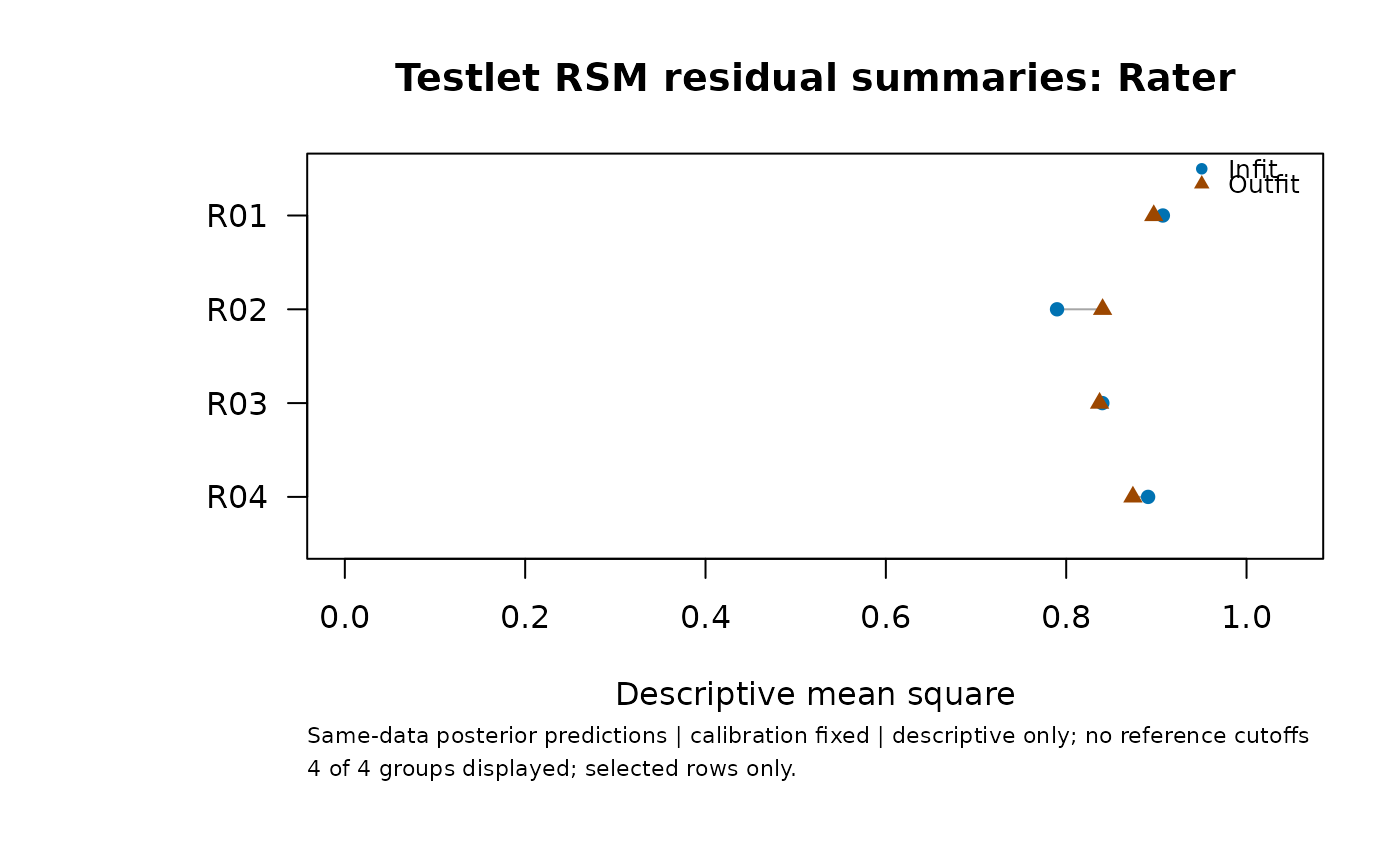
residuals$measures
#> Facet Level Selected Observed Missing Available Infit Outfit
#> 1 Rater R01 192 192 0 192 0.9072021 0.8970967
#> 2 Rater R02 192 192 0 192 0.7898564 0.8403594
#> 3 Rater R03 192 192 0 192 0.8400569 0.8370092
#> 4 Rater R04 192 192 0 192 0.8908352 0.8739722
#> Status Reason
#> 1 descriptive_only
#> 2 descriptive_only
#> 3 descriptive_only
#> 4 descriptive_only
plot(residuals)
 mfrm_results(fit, response_diagnostics = residuals, compute = "never")
#> mfrmr Results Summary
#>
#> Overview
#> Model Method N Persons Tables PlotRoutes
#> Testlet RSM MML: nested Gaussian quadrature 768 48 18 3
#>
#> Decision
#> - Interpretation: Numerical checks satisfied; model adequacy not assessed
#> - Formal inference: Target-specific limits; no general clearance
#> - Why: Numerical checks are not model-fit diagnostics or evidence of rater
#> quality.
#> - Next: Review numerical checks, interval meanings and the rating design.
#>
#> Workflow readiness
#> Domain Status
#> Model adequacy Not assessed
#>
#> Triage
#> Area Severity
#> Interpretation Review
#>
#> Triage details
#> - Interpretation: Numerical checks satisfied; model adequacy not assessed
#>
#> Plot routes
#> Type Available
#> calibration TRUE
#> scores FALSE
#> comparison FALSE
#> response_comparison FALSE
#> response_diagnostics TRUE
#> wright FALSE
#> fit_pathway TRUE
#> RequiredArtifact
#> Fitted fixed facet
#> Matching saved Person scores
#> Matching saved extended-model comparison
#> Matching saved predictive comparison
#> Matching saved response diagnostics
#> Matching source-roster Person scores
#> Matching posterior diagnostics and located groups
#>
#> Plot commands
#> - calibration: plot(res, type = "calibration")
#> - scores: plot(res, type = "scores")
#> - comparison: plot(res, type = "comparison")
#> - response_comparison: plot(res, type = "response_comparison")
#> - response_diagnostics: plot(res, type = "response_diagnostics")
#> - wright: plot(res, type = "wright")
#> - fit_pathway: plot(res, type = "fit_pathway")
#>
#> Next actions
#> Priority Area
#> 1 Interpretation
#>
#> Action details
#> - Interpretation: Review numerical checks, interval meanings and the rating
#> design. Route: res$tables$numerical_checks; res$tables$interval_basis;
#> res$tables$section_status
#>
#> Notes
#> - Numerical checks are not model-fit diagnostics or evidence of rater quality.
#> - No fitting, scoring, diagnostics or resampling is performed while collecting
#> or exporting these results.
#> - Missing assigned scores and absent assignments are different: omitted rows
#> are recorded; absent rows are not imputed.
#> - Person intervals condition on calibration and the fitted or specified normal
#> ability population; their estimation uncertainty and general coverage
#> guarantees are not included. Prior-only rows are not measured abilities.
#> - Ordinary residual diagnostics, response-MI pooling, portable calibration and
#> the Shiny viewer are unavailable for these model classes. Extended
#> Wright/pathway maps use explicitly matched saved scores and posterior
#> diagnostics.
mfrm_results(fit, response_diagnostics = residuals, compute = "never")
#> mfrmr Results Summary
#>
#> Overview
#> Model Method N Persons Tables PlotRoutes
#> Testlet RSM MML: nested Gaussian quadrature 768 48 18 3
#>
#> Decision
#> - Interpretation: Numerical checks satisfied; model adequacy not assessed
#> - Formal inference: Target-specific limits; no general clearance
#> - Why: Numerical checks are not model-fit diagnostics or evidence of rater
#> quality.
#> - Next: Review numerical checks, interval meanings and the rating design.
#>
#> Workflow readiness
#> Domain Status
#> Model adequacy Not assessed
#>
#> Triage
#> Area Severity
#> Interpretation Review
#>
#> Triage details
#> - Interpretation: Numerical checks satisfied; model adequacy not assessed
#>
#> Plot routes
#> Type Available
#> calibration TRUE
#> scores FALSE
#> comparison FALSE
#> response_comparison FALSE
#> response_diagnostics TRUE
#> wright FALSE
#> fit_pathway TRUE
#> RequiredArtifact
#> Fitted fixed facet
#> Matching saved Person scores
#> Matching saved extended-model comparison
#> Matching saved predictive comparison
#> Matching saved response diagnostics
#> Matching source-roster Person scores
#> Matching posterior diagnostics and located groups
#>
#> Plot commands
#> - calibration: plot(res, type = "calibration")
#> - scores: plot(res, type = "scores")
#> - comparison: plot(res, type = "comparison")
#> - response_comparison: plot(res, type = "response_comparison")
#> - response_diagnostics: plot(res, type = "response_diagnostics")
#> - wright: plot(res, type = "wright")
#> - fit_pathway: plot(res, type = "fit_pathway")
#>
#> Next actions
#> Priority Area
#> 1 Interpretation
#>
#> Action details
#> - Interpretation: Review numerical checks, interval meanings and the rating
#> design. Route: res$tables$numerical_checks; res$tables$interval_basis;
#> res$tables$section_status
#>
#> Notes
#> - Numerical checks are not model-fit diagnostics or evidence of rater quality.
#> - No fitting, scoring, diagnostics or resampling is performed while collecting
#> or exporting these results.
#> - Missing assigned scores and absent assignments are different: omitted rows
#> are recorded; absent rows are not imputed.
#> - Person intervals condition on calibration and the fitted or specified normal
#> ability population; their estimation uncertainty and general coverage
#> guarantees are not included. Prior-only rows are not measured abilities.
#> - Ordinary residual diagnostics, response-MI pooling, portable calibration and
#> the Shiny viewer are unavailable for these model classes. Extended
#> Wright/pathway maps use explicitly matched saved scores and posterior
#> diagnostics.