
Build a rating-scale diagnostics report
Arguments
- fit
Output from
fit_mfrm().- diagnostics
Optional output from
diagnose_mfrm().- whexact
Use exact ZSTD transformation for category fit.
- drop_unused
If
TRUE, remove categories with zero count from the displayed category table. Usage totals still cover the full declared scale; unavailable counts remain visible, and score-support caveats are retained.
Value
A named list with:
category_table: category-level counts, expected counts, fit, and ZSTDthreshold_table: model step/threshold estimatessummary: one-row summary with available/unavailable category counts and adjacent-threshold comparisons. Category-fit means identify their available denominators and describe displayed rows. Missing fit statistics/flags stayNA, including unused categories with no estimable category fit.category_usage: counts across the full scale, beforedrop_unusedthreshold_coverage: available, unavailable and decreasing adjacent-pair counts;NotApplicabledistinguishes binary scales from missing estimatescaveats: structured score-support warning/review rowsdiagnostic_mode: character scalar carried fromdiagnostics$diagnostic_mode("legacy","both", or"marginal_fit"); used by downstream reporting helpers to pick the correct expected-count basismarginal_fit: list bundle fromdiagnostics$marginal_fitwhen strict marginal fit was computed, otherwiseNULL. Carries the raw OverallRMSD / OverallMaxAbsStdResidual / per-cell tables that feed theMarginalOverallRMSDcolumns insummary.
Details
This helper provides category usage/fit statistics and threshold summaries
for reviewing score-category functioning.
The category usage portion is a global observed-score screen. In PCM fits
with a step_facet, threshold diagnostics should be interpreted within each
StepFacet rather than as one pooled whole-scale verdict.
Typical checks:
sparse category usage (
Count,ExpectedCount)category fit (
Infit,Outfit,ZStd)threshold ordering within each
StepFacet(threshold_table$Estimate,GapFromPrev)
Interpreting output
Start with summary:
UsedCategoriesclose to totalCategoriessuggests that most score categories are represented in the observed data.very small
MinCategoryCountindicates potential instability.ThresholdMonotonic = FALSEindicates disordered thresholds within at least one threshold set. In PCM fits, inspectthreshold_tablebyStepFacetbefore drawing scale-wide conclusions.
Then inspect:
category_tablefor global category-level misfit/sparsity.threshold_tablefor adjacent-step gaps and ordering within eachStepFacet.
For MML step uncertainty, inspect
diagnostics$parameter_uncertainty$steps from diagnose_mfrm(). A bare fit
supplies point estimates to threshold_table; passing separate diagnostics
here does not attach their SEs or intervals to that table. Check SE_Status
and, when present, CIEligible / CIUse before reporting intervals. Retain
StepFacet for PCM threshold families. A facet-location SE is not a step SE.
Typical workflow
Fit model:
fit_mfrm().Build diagnostics:
diagnose_mfrm().Run
rating_scale_table()and reviewsummary().Use
plot()to visualize category profile quickly.
Further guidance
For a plot-selection guide and a longer walkthrough, see
mfrmr_visual_diagnostics and
vignette("mfrmr-visual-diagnostics", package = "mfrmr").
Output columns
The category_table data.frame contains:
- Category
Score category value.
- Count, Percent
Observed count and percentage of total. With observation weights, counts are sums of weights, not independent sample sizes. Missing or invalid scores/weights make the usage counts unavailable.
- AvgPersonMeasure
Mean person measure for respondents in this category.
- Infit, Outfit
Category-level fit statistics.
- InfitZSTD, OutfitZSTD
Standardized fit values.
- ExpectedCount, DiffCount
Expected count and observed-expected difference.
- LowCount
Logical;
TRUEif count is below minimum threshold.- InfitFlag, OutfitFlag, ZSTDFlag
Fit-based warning flags.
- ZeroCount, UnusedCategoryType, WeaklyIdentified, CategoryCaveat
Structured score-support caveats for retained zero-count categories.
The threshold_table data.frame contains:
- Step
Step label (e.g.,
Step_1,Step_2). UseLowerCategoryandUpperCategoryto identify the corresponding score transition.- Estimate
Estimated threshold/step difficulty (logits).
- StepFacet
Threshold family identifier when the fit uses facet-specific threshold sets.
- GapFromPrev
Difference between adjacent numbered thresholds within the same
StepFacet. Missing thresholds are not skipped to form a gap. No automatic category-merging rule is applied.- ThresholdMonotonic
Logical flag repeated within each threshold set.
FALSErecords at least one decreasing adjacent pair;TRUErequires every expected pair to be available and nondecreasing, allowing numerical differences up tosqrt(.Machine$double.eps). Equal thresholds meet this descriptive condition. Otherwise the flag isNA. A binary scale has only one threshold and no applicable ordering comparison. This is a statement about point estimates, not a test of category adequacy.- LowerCategory, UpperCategory, WeaklyIdentified, ThresholdCaveat
Adjacent score-category support metadata. Thresholds adjacent to retained zero-count categories are flagged for cautious interpretation.
References
Andrich, D. (1978). A rating formulation for ordered response categories. Psychometrika, 43(4), 561-573. doi:10.1007/BF02293814
Masters, G. N. (1982). A Rasch model for partial credit scoring. Psychometrika, 47(2), 149-174. doi:10.1007/BF02296272
Linacre, J. M. (2002). What do Infit and Outfit, mean-square and standardized mean? Rasch Measurement Transactions, 16(2), 878. (Source for the 0.5-1.5 mean-square heuristic review interval; this is not a source for threshold-gap rules.)
Wind, S. A. (2023). Detecting rating scale malfunctioning with the partial credit model and generalized partial credit model. Educational and Psychological Measurement, 83(5), 953-983. doi:10.1177/00131644221116292 (Recent simulation evidence on PCM- and GPCM-based rating-scale diagnostics; useful for interpreting the
summary(t8)$summaryflags in theGPCMroute.)
Examples
# \donttest{
# Load the package and example ratings
library(mfrmr)
toy <- load_mfrmr_data("example_operational")
# Fit the model
fit <- fit_mfrm(
data = toy,
person = "Person",
facets = c("Rater", "Criterion"),
score = "Score",
method = "MML",
model = "RSM"
)
# Review category use and the fitted transitions between scores
categories <- rating_scale_table(fit)
review <- summary(categories)
review$summary
#> Categories DisplayedCategories AvailableCategoryCounts
#> 1 4 4 4
#> UnavailableCategoryCounts UsedCategories UnusedScoreCategories
#> 1 0 4
#> WeaklyIdentifiedThresholds MinCategoryCount MaxCategoryCount
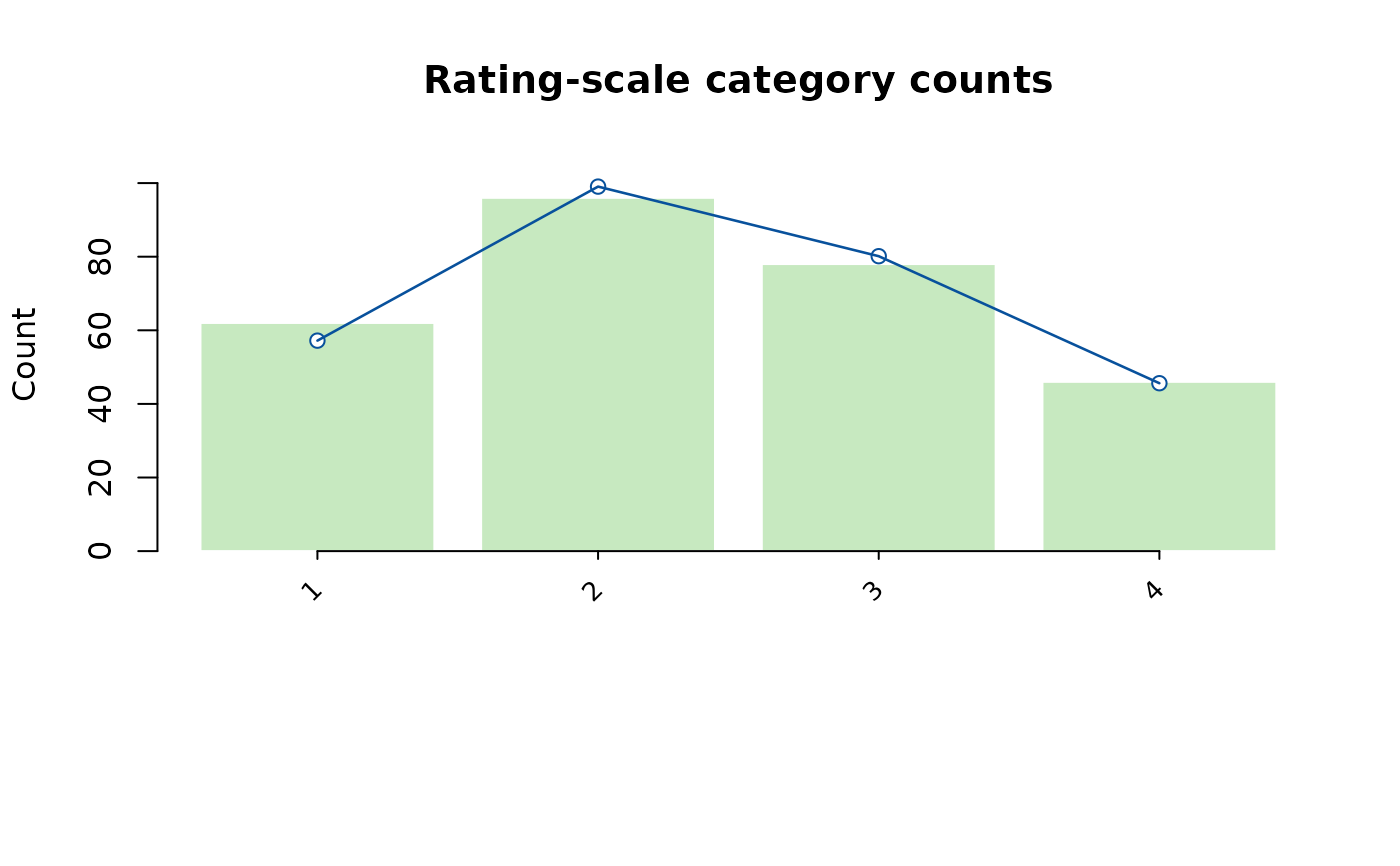
#> 1 0 46 96
#> MeanCategoryInfit AvailableCategoryInfit MeanCategoryOutfit
#> 1 1.079498 4 0.9991048
#> AvailableCategoryOutfit ThresholdMonotonic ThresholdComparisons
#> 1 4 TRUE 2
#> AvailableThresholdComparisons UnavailableThresholdComparisons
#> 1 2 0
#> ThresholdOrderNotApplicable DiagnosticMode
#> 1 FALSE both
#> ExpectedCountBasis MarginalFitAvailable
#> 1 legacy_plugin + latent_integrated_first_order_counts TRUE
#> MarginalOverallRMSD MarginalMaxAbsStdResidual MarginalFlaggedCategories
#> 1 0.006236843 0.4330932 0
#> MarginalClassifiedCategories MarginalUnclassifiedCategories
#> 1 4 0
# Bars show observed counts; the line shows model-expected counts
# Recreate saved tables with the original fit and diagnostics after updating.
plot(categories)
 # }
# }